
Public AI / REPORT 001
More than another chatbot? Inside Thailand’s OKMD AI Playground
We tested the interface, examined its API, and traced the THB 28.355 million programme behind it to see who this public AI platform really helps—and where it still falls short.
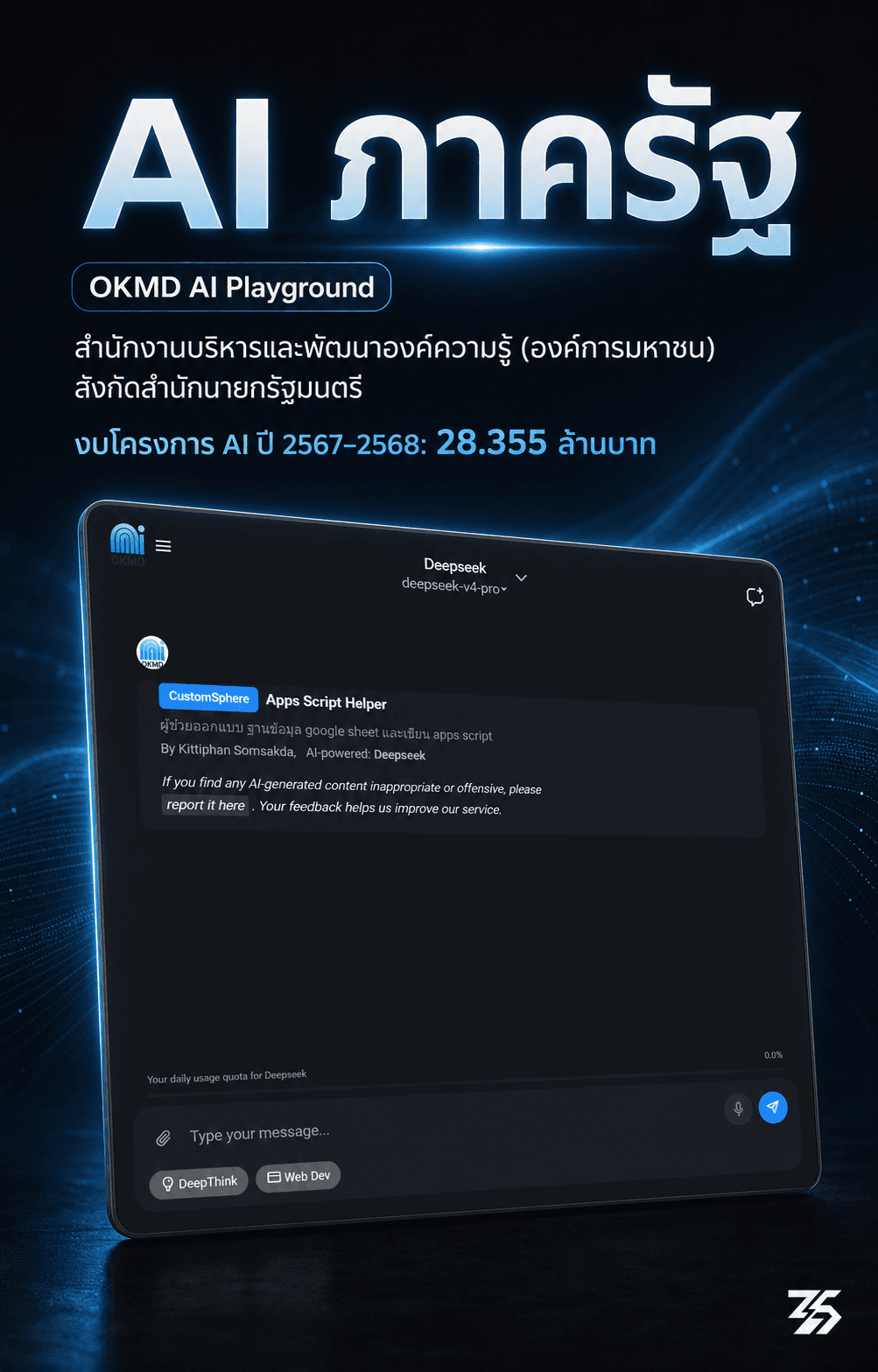
Note: This article reflects personal observations from the public website, project documents, and hands-on testing.
OKMD AI Playground is operated by Thailand’s Office of Knowledge Management and Development (Public Organization), under the Office of the Prime Minister. It gives TK Park members access to multiple AI models, daily quotas, and specialist CustomSphere assistants through one interface.
The project’s purpose
OKMD positions the broader “Learning Metropolis through AI” initiative as public digital learning infrastructure. It connects knowledge portals and maps with podcasts, workshops, AI literacy bootcamps, and hackathons. The Playground should therefore be judged first as part of a lifelong-learning ecosystem—not as a full coding agent.
1. Tool calling and live sources
In the tested web interface, no visible tool-calling flow searched the web or attached external sources. That makes it difficult to distinguish model memory from current, verifiable information. A public knowledge service would benefit from opt-in web search, per-claim citations, freshness labels, and direct links into trusted OKMD and government collections.
2. Code should be runnable
Short snippets are not enough for real Google Apps Script work. Useful output should include the sheet schema, complete files, trigger setup, test data, expected errors, and a safe way to run or export the project.
3. Web Dev is not yet a developer agent
A Web Dev mode does not by itself provide a harness that can inspect a repository, edit files, run commands, execute tests, and verify results. Sandboxed workspaces and permissioned GitHub or GitLab connections could bridge that gap without giving an agent uncontrolled access.
4. The API is a real strength
OKMD exposes an OpenAI-compatible API, allowing developers to change the base URL and connect OpenAI SDK-compatible tools. This makes the platform more than a chat hub. Documentation lists models from OpenAI, Claude, Gemini, DeepSeek, Qwen, Meta, Mistral, Nova, and Perplexity.
Chat-completions compatibility does not automatically guarantee identical support for tool calling, structured outputs, multimodal inputs, or streaming. A tested compatibility matrix for every model would make the API considerably easier to trust.
What should come next
Clear model cards, verifiable sources, transparent tool use, runnable code outputs, and outcome-based metrics would move the Playground from an AI hub toward a genuine learning and working environment.
Supporting context: OKMD is under the Office of the Prime Minister, and the 2024–2025 budget for the “Learning Metropolis through AI” project totals THB 28.355 million.
SOURCES / 03